Spoiler warning: We are going deep into those ugly yellow rooms and discussing Clark, Mary, the creatures, and the ending. If you haven’t watched Backrooms yet, exit now while you can still find the door.
First of all, if I walk through the basement of my furniture store and discover a doorway that was not there yesterday, I’m calling somebody.
A contractor.
The landlord.
The fire department.
Jesus.
What I am NOT doing is walking through it alone to investigate the endless fluorescent nightmare on the other side.
Clark apparently feels differently.
Backrooms, released by A24 in U.S. theaters on May 29, 2026, is directed by Kane Parsons from a screenplay by Will Soodik. It stars Chiwetel Ejiofor as Clark, Renate Reinsve as his therapist Dr. Mary Kline, and Mark Duplass as Async scientist Phil. The R-rated movie runs 1 hour and 50 minutes. (a24films.com) (rottentomatoes.com)
And yes, this is the feature film version of the internet phenomenon that started with creepy images of empty, vaguely familiar rooms before Parsons expanded the idea into his viral YouTube series as Kane Pixels. (a24films.com)
Clark Finds the Worst Expansion Space in Retail History
Clark is having a rough time.
His marriage has fallen apart.
He’s drinking too much.
His dream of becoming an architect didn’t work out.
And now he’s living inside his struggling furniture store, Cap’n Clark’s Ottoman Empire, occasionally dressing like a pirate for commercials.
Life has humbled this man thoroughly.
Then strange electrical problems lead him into the basement, where he discovers an opening in the wall.
Behind it?
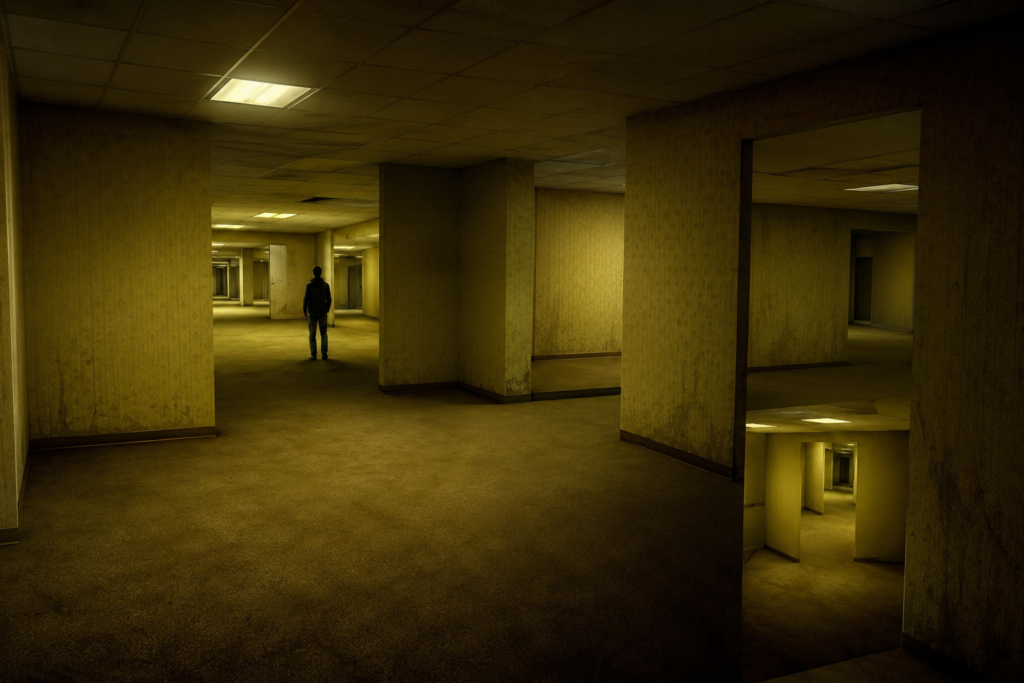
An enormous maze of empty rooms with yellow walls, dirty carpeting and fluorescent lights that sound like they haven’t been changed since 1987.
Clark describes the place as something resembling a faulty copy of reality.
That’s exactly what it feels like.
It’s familiar enough that your brain keeps saying:
“I’ve been here before.”
But wrong enough that the rest of you says:
“No you have NOT. Keep moving.”
The rooms seem endless, and they begin recreating pieces of Clark’s real life, but never quite correctly. Furniture appears. Signs look familiar but contain nonsense. Architecture almost makes sense until a doorway is suddenly the wrong size or a hallway decides gravity is optional.
Then Clark Decides to Bring Coworkers Down There
This is where I would’ve resigned.
Clark convinces employees Bobby and Kat to help him investigate.
Sir, this was not in the job description.
I came here to sell sectionals.
Bobby enters with a camera, giving the movie one of its clearest connections to Parsons’ original found-footage shorts.
Unfortunately, something else is wandering around down there.
Bobby discovers that personally.
And permanently.
The creatures inside the Backrooms are called Still Lifes, distorted attempts by the space to recreate people the same way it recreates rooms and objects.
Except apparently the Backrooms’ human-copying software is still in beta.
Some of these things look almost human.
Others look like somebody asked a broken printer to reproduce a person from memory.
Clark Starts Preferring the Backrooms to Real Life
This is where the movie becomes more interesting than:
“People get lost in creepy office building.”
Clark keeps going back.
The Backrooms begin reconstructing pieces of his memories, and rather than recognizing that as the giant supernatural red flag that it is, he becomes fascinated.
Because Clark hates his actual life.
His marriage failed.
His career disappointed him.
Reality constantly reminds him of everything that didn’t turn out the way he imagined.
But the Backrooms?
They can recreate the past.
Badly, yes.
But sometimes a comfortable lie is tempting when the truth hurts.
The movie gradually becomes less about finding the exit and more about a man choosing nostalgia over reality.
Which is deep.
But I’m still going to need somebody to replace those fluorescent bulbs.
Mary Goes Looking for Clark
Eventually Clark disappears, leaving his therapist Mary a disturbing message.
Mary goes to the furniture store and discovers that her patient was not hallucinating.
There really is another world behind that wall.
And now Mary walks into it looking for him.
This is exactly why therapists need boundaries.
Mary eventually finds Clark, but by this point he has completely embraced the Backrooms.
He’s sitting at a bizarre dinner table with several Still Lifes and forces Mary into another version of their therapy role-play.
Clark is still blaming everybody else for how his life turned out.
Mary finally tells him what he doesn’t want to hear:
His marriage didn’t collapse because the universe betrayed him.
Clark played a role in destroying it.
That briefly snaps him back to reality.
Unfortunately, reality has brought company.
Captain Clark Is Absolutely Not Employee of the Month
The biggest creature stalking the movie is a grotesque recreation of Clark’s pirate-store persona.
Yes.
The monster is essentially Nightmare Furniture Pirate Clark.
It has details copied from the costume Clark wore in his commercials, including distorted versions of his pirate accessories.
The creature is almost like the Backrooms looked at Clark’s worst qualities, ego, anger, resentment, and said:
“I can make that bigger.”
Then it kills him.
Which is one way to handle a negative performance review.
Backrooms Ending Explained
After Clark dies, Captain Clark turns its attention to Mary.
Mary runs through the maze and finally reaches what looks like the furniture showroom.
Except, of course, it isn’t.
The Backrooms have copied that too.
Girl.
At that point I’m sitting on the floor.
You win.
She eventually fights back using a piece of concrete connected to her childhood home—a reminder of her own painful memories rather than a fantasy version of them.
Then armed researchers from Async arrive.
They subdue the creature and take Mary into custody.
Async scientist Phil explains that the company has been studying the Backrooms, but here’s the comforting part:
They don’t really understand them either.
Wonderful.
The people in hazmat suits don’t know what’s going on.
Everybody sleep well tonight.
Phil questions Mary and makes it pretty clear that Async isn’t simply going to hand her a bus ticket and send her home.
Then comes the final nightmare.
Back inside the maze, the Backrooms have started copying Mary’s memories.
And we see a distorted Still Life version of Mary sitting silently in a replica of the room where the real Mary is being questioned.
No, thank you.
So What Does the Ending Mean?
The movie intentionally doesn’t give us one neat explanation.
Parsons has even said he doesn’t want to dictate one official interpretation of the ending, although he has confirmed that the whole thing is not simply a dream.
The clearest theme is memory.
The Backrooms consume pieces of people’s experiences and reproduce them imperfectly.
Clark becomes trapped because he’d rather live inside corrupted versions of his past than deal with his present.
Mary does something different.
She carries painful memories too, but she doesn’t surrender herself to them.
And yet the ending suggests that once the Backrooms have encountered you…
they remember you.
That’s much creepier than explaining the whole place with some five-minute scientist speech about dimensional portals.
Sometimes horror needs to hush and let me be uncomfortable.
Horror Tea Verdict
Backrooms isn’t traditional jump-scare horror.
It’s weird.
Slow.
Claustrophobic.
And deliberately confusing.
Kane Parsons is much more interested in making a hallway feel threatening than having somebody pop out of a closet every seven minutes.
And surprisingly?
It works.
Chiwetel Ejiofor gives Clark enough sadness and ugliness to make his descent believable, while Renate Reinsve becomes the emotional anchor once Mary enters the maze.
The real star, though, is the environment.
Those rooms feel familiar in a way that’s almost impossible to explain, and that’s exactly why they’re disturbing.
Rotten Tomatoes currently has Backrooms at 87% from more than 300 critic reviews, with a 74% verified audience score. (rottentomatoes.com)
Horror Tea Rating: ☕☕☕☕ out of 5
Creepy, strange and much smarter than “people get lost in yellow hallways” has any right to be.
And if I ever see an unexplained doorway appear in my basement?
I’m putting a bookshelf in front of it.
Mystery solved.